Product update
Academy setup, blueprint to live
Build one academy model through six clear launch stages.
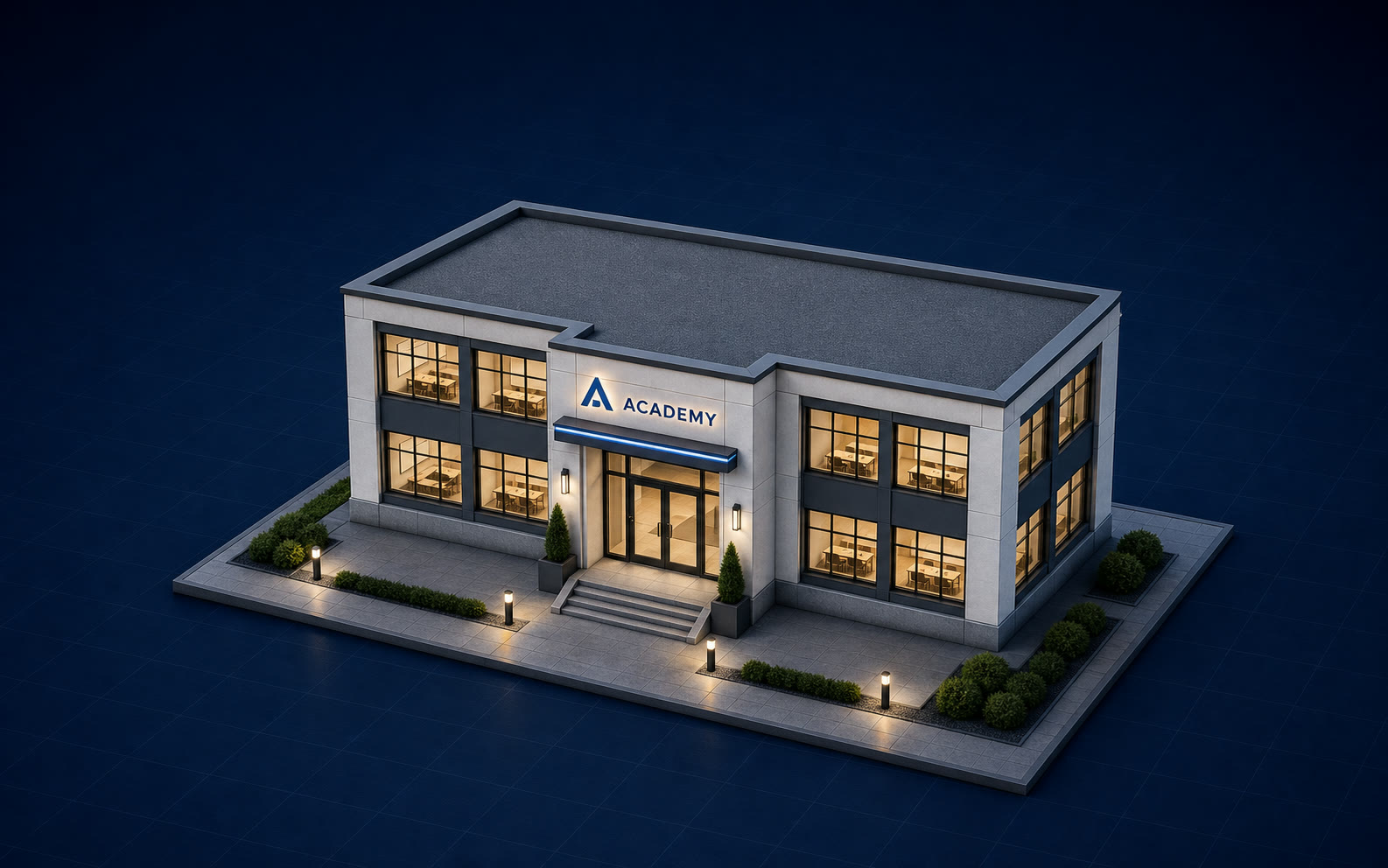
Starting an academy platform should feel like building a coherent operation, not completing an unrelated collection of forms. Akademate is introducing a six-stage visual setup journey that keeps one academy model in view as its structure, spaces, programmes, people, operations and identity come together.
01
One academy remains visible throughout setup
The journey begins with an isometric blueprint and ends with the same academy illuminated and ready. The footprint, entrance, classrooms and visual perspective remain consistent across every stage so the operator can understand what has been configured and what still needs attention.
This continuity replaces a generic percentage with a concrete model. Progress is represented by the academy becoming more complete: structure appears, surfaces are added, spaces become usable, identity is applied and the final operation goes live.
02
Six stages connect setup to real operations
Academy Blueprint defines the operating model and launch priorities. Campuses and Spaces represents locations, rooms and online capacity. Programmes and Offers adds schedules, enrolment rules and pricing. People and Access prepares the responsibilities of teams, teachers, learners and families.
Learning and Operations connects campus delivery, communication, payments and reporting. Academy Live completes brand, website and launch readiness. The stages are designed as an orientation layer rather than a replacement for the detailed settings behind each decision.
- Academy blueprint
- Campuses and spaces
- Programmes and offers
- People and access
- Learning and operations
- Academy Live
03
A shared contract for public storytelling and onboarding
The six stages are defined in a reusable Akademate interface contract. The public website uses that contract to explain the product journey, while the future tenant onboarding experience can consume the same stage identifiers, descriptions and visual assets.
Centralising the model avoids two versions of setup drifting apart. A change to the meaning or order of a stage can be reviewed once and then reflected consistently wherever the setup journey appears.
04
Progress should reflect completed configuration
The visual sequence is not intended to claim that provisioning is complete because an image has changed. In the operational onboarding flow, each state will be driven by explicit configuration evidence such as a saved campus, a published offer, assigned roles or approved launch settings.
That distinction keeps the experience motivating without turning presentation into false status. Operators should be able to open a stage, see the outstanding decisions and understand which action will move the academy forward.
05
Designed for one location or a growing network
The compact academy visual represents the first operating unit, but the setup contract includes multiple campuses, rooms and online capacity. A growing organisation can establish shared standards while configuring the details that belong to each location or entity.
This creates a consistent starting point for an independent academy, a specialist studio, a seasonal programme or a multi-site group. The interface stays recognisable even as the operational model becomes more sophisticated.
06
What comes next
The public sequence is now the visual foundation for the onboarding work that follows. The next product phase will connect each stage to saved tenant configuration, readiness checks, permission-aware tasks and a clear return path when information needs to be revised.
Akademate will validate the operational wiring separately before describing the onboarding workflow as complete. The immediate improvement is a clearer product story and a reusable model for turning setup into an understandable, progressive experience.
Connect the idea to your academy.
Explore how Akademate can connect your public experience, daily operation and learning journey.
See Akademate in action